Eliminate manual classification with data classification tools that deliver faster, more consistent results.
Organizations reap the most benefits from their data classification solution when labels are applied to their documents and other data at the point of creation. But users are often prone to mishandling or misclassifying that data, particularly when compliance requirements are complex or security policies are unclear. Fortra Data Classification delivers policy guidance via alert dialogues that prevent inappropriate actions and reinforce security awareness training.
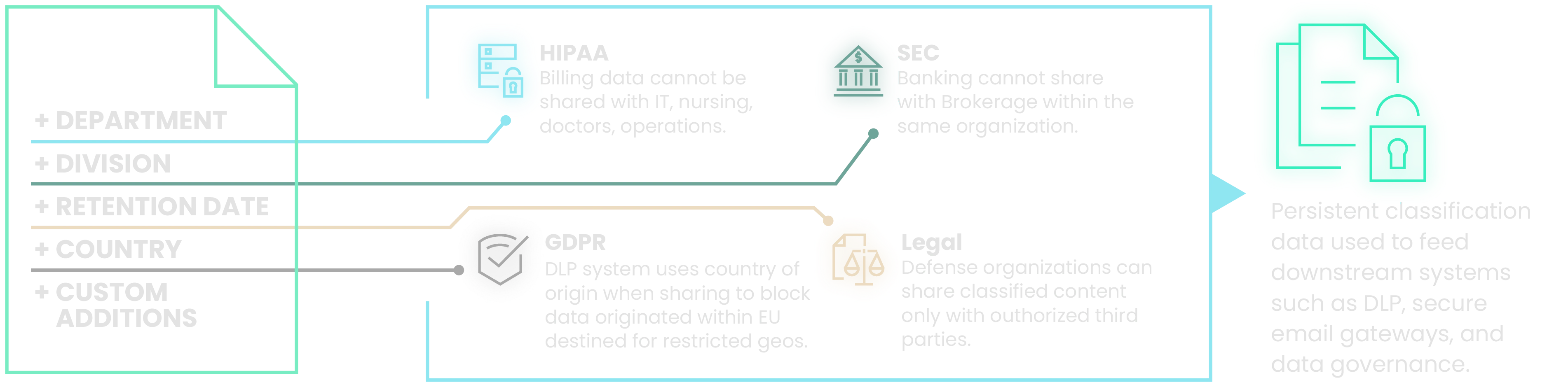
Even when classification labels are applied early in the data lifecycle, however, those labels are most useful when they travel with the data as opposed to only existing within the system that applied the labels. Fortra Data Classification applies persistent labels and enriches metadata with context like data origin, time of day, and user actions — all of which can be leveraged by downstream security tools, create traceable records for compliance audits, and inform policy enforcement across boundaries.
While classification at the point of creation is ideal, the reality is that organizations have an ever-growing volume of data at rest, and many standalone data classification solutions are unable to retroactively discover and classify that data. Our solution scans on-premise file shares and SaaS storage solutions like Microsoft SharePoint, SharePoint Online, OneDrive, Box, and Dropbox, automatically applying persistent labels to the data it discovers.
Fortra Data Classification Suite’s (DCS) Intelligent Protection, powered by machine learning, allows IT administrators can train the software to recognize and match company-specific information to the data categories they define. Our industry-proven algorithms identify document categories, enabling organizations to identify and protect company-specific document types such as board-level communications, project plans, M&A communications, or IP in motion and at rest.
Wherever sensitive data lives, Fortra Data Classification adapts to the regulations and workflows that matter to your industry.
Government agencies and defense contractors handle some of the most sensitive defense and intelligence data in existence—and face some of the most stringent handling requirements. Fortra Data Classification helps these organizations and entities apply consistent, policy-driven labels to documents and emails, ensuring that controlled unclassified information (CUI) and classified materials are marked, handled, and shared appropriately. Data Classification provides the foundation for compliant information management and secure messaging to meet specific standards set by regulations like ITAR or CMMC across your entire data environment.
Moreover, Fortra Data Classification also helps organizations align with NATO STANAG principles, enabling consistent labeling, metadata enforcement, and secure information sharing across multinational environments.
Healthcare organizations must carefully govern access to protected health information (PHI) across a complex ecosystem of systems, users, and third-party partners. Fortra Data Classification enables healthcare teams to identify and label sensitive patient data at the point of creation, ensuring it’s handled consistently and in accordance with regulations like HIPAA and HITECH.
By embedding persistent metadata into documents and emails, Data Classification also helps downstream security controls prevent unauthorized or accidental PHI disclosures before they occur.
Financial institutions manage vast volumes of sensitive client and transactional data, making data governance both a regulatory obligation and a business imperative.
Fortra Data Classification helps financial organizations classify data in alignment with frameworks like PCI DSS, SOX, and DORA, enabling consistent policy enforcement across documents, emails, and file storage. Clear classification labels reduce the risk of accidental exposure and give security teams the context they need to apply the right controls to the right financial data.
For organizations subject to broad data privacy regulations like GDPR, CCPA, LGPD, or similar frameworks, knowing what data you have and where it lives is the first step toward compliance.
Fortra Data Classification helps teams identify and label personally identifiable information (PII) and other sensitive data across their environment, making it easier to enforce retention policies, respond to data subject requests, and demonstrate accountability to regulators, giving your organization the visibility and control needed to manage data responsibly at scale.
Fortra Data Classification’s persistent labels and metadata enable organizations to automate the security tools they already use, meaning they’ll take more accurate and effective data security actions. But some DLP and data classification stacks may lack comprehensive file type coverage, can’t easily align DLP policies with classification schemas, and are limited to protecting endpoints.
The SDK-based integration between Fortra Data Classification and Fortra DLP, however, closes these gaps without increasing the overhead associated with aligning disconnected tools.
Explore other configurations and models that might suit your needs.
Recommended
#Data-Security
Recommended
#Brand-Protection
Recommended
#Offensive-Security
Our team of experts is ready to help you find the perfect solution for your business needs. Get personalized advice and competitive quotes.
We're here to help with any questions